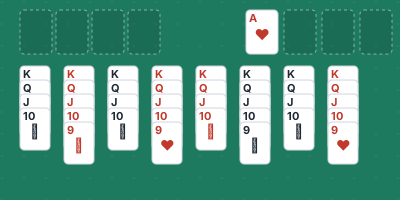
Play Spiderette Solitaire Online for Free
Spiderette Solitaire is Spider played with a single deck. You get the same goal - complete King-to-Ace runs in one suit - but everything fits on seven columns and every suit is in play from the first deal. The tighter board makes it a sharp, focused puzzle for players who already know Spider and want it distilled.
How to Play Spiderette
- Seven columns are dealt Klondike-style: the first column gets 1 card, the second 2, up to seven in the last column. Only the top card of each column starts face up. The remaining 24 cards form the stock.
- Build the tableau down in rank regardless of suit - a red Nine may sit on a black Ten.
- You can pick up a face-up card together with the run beneath it, but the whole group only moves if it is a descending run in a single suit.
- Complete a run from King down to Ace in one suit and it clears off the board automatically. Four full runs win the game.
- When you are stuck, click the stock to deal one new face-up card onto each of the first columns. The final deal may be shorter than seven cards once the stock runs low.
- Any card or valid single-suit run may be placed in an empty column.
- Clear all four King-to-Ace runs - one per suit - to win.
Spiderette Rules
Objective
Move all 52 cards into four completed runs, each running from King down to Ace in a single suit. Runs leave the board as they are completed.
Setup
One standard 52-card deck is dealt across seven tableau columns in a 1-2-3-4-5-6-7 cascade, with only the top card of each column face up. The 24 leftover cards wait face down in the stock.
Tableau
Columns build downward by rank in any suit mix, so a Queen of Hearts accepts a King of Spades. A group move, however, must be a perfectly ordered descending run of one suit - mixed-suit stacks travel one card at a time.
Stock
Click the stock to deal one face-up card onto each column, starting from the left. Every column must hold at least one card before you may deal. Because the stock holds 24 cards, you get three full waves of seven and one short wave of three.
Completed Runs
The moment a column holds a King-to-Ace run in one suit, all thirteen cards leave the tableau and park in the finished area. One completed run per suit wins the game.
Scoring
The game starts at 500 points. Every move costs 1 point and every completed run adds 100, so a perfect game finishes back at 900.
Strategy
['Uncover face-down cards as fast as you can. With only 21 hidden cards the board looks open, but each one you flip can unlock an entire column, and you cannot complete a suit run while its cards are buried.', 'Chase singles first. Because a mixed-suit stack moves one card at a time, your early game is about freeing individual cards and building short same-suit runs, not about spectacular long moves.', 'Save the stock for the moment it helps. Every wave buries up to seven fresh cards under your work, so deal before you run out of options - not before you run out of ideas.', 'Keep at least one column free for assembly once the mid-game starts. An empty column is where you dismantle a mixed stack and rebuild it as a single-suit run, and losing your last empty column is how most losses happen.', 'Build toward Kings. A run headed by a King is the cheapest run to finish, because a King can never be moved onto anything - only emptied columns or completed runs get rid of it.', 'Sort by suit as early as possible. In a one-deck game there are only thirteen cards of each suit, so even pairing two or three same-suit cards in a column early makes the endgame run dramatically smoother.']
Common Mistakes
['Dealing a wave with an empty column on the board. The engine refuses the deal until every column holds a card, so an ignored empty column can stall the whole game.', 'Treating Spiderette like two-deck Spider. There is no second copy of any card here - if a spade you need is buried under hearts, nothing will replace it.', 'Stacking mixed suits deep. Every mixed card in a column is a card that must be moved again later, and single-card shuffling is exactly what makes Spiderette slow.', 'Wasting empty columns on short dumps. Filling your last free column with a random card instead of using it to reorder a stack usually costs the game a few moves later.', 'Ignoring suit when choosing between two legal drops. Two moves may both be legal, but the one that groups suits saves you five moves down the line.', 'Clicking the stock on autopilot at the start. The opening tableau always has safe moves; spending a wave in the first minute buries cards you will soon need.']
Winning
The game is won the instant the fourth King-to-Ace run leaves the tableau. Whatever the score, four completed runs is the only win condition.
Tips & Strategy
- Flip a face-down card every move if you can - uncovering is worth more than any single build.
- Never deal from the stock while a column is empty; fill it first, even with a lone card.
- Keep large same-suit runs together. Breaking a five-card spade run to make one extra move is almost always a loss.
- Use empty columns as workshops: park a stack there, strip the suits apart, rebuild in order.
- Count the stock: three waves of seven and one of three. Plan your endgame around that last short wave.
- Stuck on all four suits? Warm up on 1-suit Spider - same ten-column game, every card a spade.
Frequently Asked Questions
What is Spiderette?
Spiderette is Spider Solitaire played with one deck instead of two. The goal is the same - complete King-to-Ace runs in a single suit - but the tableau shrinks to seven columns dealt Klondike-style and the stock holds just 24 cards. It is the classic one-deck relative of Spider, and a search for one-deck Spider Solitaire lands on exactly this game.
How many decks is Spiderette played with?
One - 52 cards, four suits, thirteen of each. The name sometimes confuses people who search for 4 deck Spider Solitaire, but Spiderette has nothing to do with deck count; the number four in Spider rules always refers to suits. If you want the two-deck version, that is regular Spider Solitaire.
Is Spiderette harder than Spider Solitaire?
Card for card, yes. Two-deck Spider gives you duplicate cards, so a blocked card always has a twin somewhere. In Spiderette every card is unique, which means one bad burial can be permanent. The smaller board is easier to read, but the single deck is less forgiving - most players find Spiderette closer to 4-suit Spider in difficulty than to the 1-suit game.
Is Spiderette winnable?
Often, but not always. Like all four-suit Spider family games, some deals are lost from the shuffle no matter how well you play. The upside: games are short, the board is compact, and the unlimited undo here lets you rewind a whole wave if a deal turns out badly. Treat three of four completed runs as a strong game.
Similar Solitaire Games