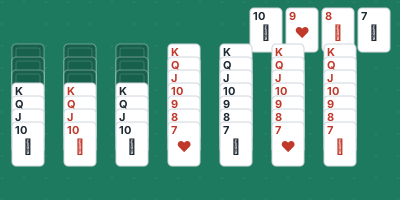
Play Free Klondike Solitaire Online (Draw 1)
Free Klondike Solitaire - also called Draw 1 or Turn One - is the classic solitaire card game most people picture when they hear the word solitaire. Build four foundation piles from Ace to King, one suit per pile, using smooth drag-and-drop controls. This is the traditional Draw 1 version, where you flip one card at a time from the stock pile.
How to Play Klondike Solitaire
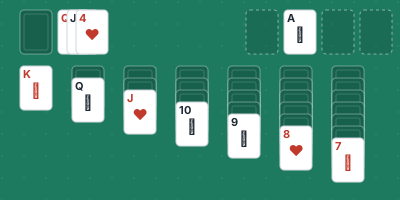
- A standard 52-card deck is dealt into seven tableau columns. The first column has 1 card, the second has 2, and so on up to 7 cards in the last column. Only the top card of each column starts face up.
- Look for any Aces among the face-up cards. Move each Ace to a foundation pile above the tableau.
- Build foundations in ascending order by suit: Ace, 2, 3, and so on up to King.
- Build the tableau in descending order with alternating colors. For example, place a red 7 on a black 8.
- When a face-down card becomes the top card of a column, flip it over. Empty tableau columns can only be filled with Kings.
- If no useful moves remain on the tableau, click the stock pile to flip one card face up into the waste pile. The top waste card can be played onto the tableau or foundations.
- Move all 52 cards to the four foundations to win the game.
Klondike Solitaire Rules
Objective
Move all 52 cards to four foundation piles, each built up in suit from Ace to King.
Setup
Seven tableau columns are dealt left to right: column 1 gets 1 card, column 2 gets 2 cards, and so on through column 7 with 7 cards. The top card of each column is face up; the rest are face down. The remaining 24 cards form the stock pile.
Tableau
Within the tableau, build down in alternating colors (red on black, black on red). You can move a single card, or a valid descending alternating-color sequence together as a group. Only Kings (alone or at the head of a valid sequence) may occupy an empty column.
Foundations
Foundations build up in suit from Ace to King. Any exposed Ace can start a foundation. Cards on foundations cannot be moved back to the tableau in classic Klondike.
Stock And Waste
In Draw 1 Klondike, clicking the stock flips one card to the waste pile. The top waste card is available for play. When the stock is empty, the waste pile is turned over to form a new stock. In this version, passes through the stock are unlimited.
Scoring
Standard scoring awards 10 points for each card sent to a foundation and 5 points for each tableau card turned face up. You can ignore the score entirely and simply play to win.
Strategy
Draw 1 is the version most people mean by solitaire, and it is also the fairest: turning one card at a time means every card in the stock can be reached, which is why a careful player wins roughly 30-40% of deals and a perfect solver wins about 82%. Start by reading the tableau rather than the stock. Twenty-one of the 28 tableau cards begin face down, so your first job is to open the deepest column, not to play the obvious card that is already showing. Keep an empty column in reserve if you can - only a King may fill it, but it is the most useful space on the board - and hold Aces and Twos back until you are sure you do not need them as somewhere for other cards to sit. Because the stock recycles indefinitely here, access is never the constraint: the order of the cards is. Play the tableau first, then cycle.
Common Mistakes
The most common one is playing the first legal move instead of the best one; Klondike punishes speed more than most variants. The second is sending every low card to the foundations as soon as it appears - that is 10 points, but a Two on the foundation is a Two you can no longer use as a landing spot for a red Three. The third is cycling the stock before the tableau has been worked over, which usually means you spend a pass and return to exactly the same position. And players often assume a board is dead once the stock has run out: the stock refills as often as you like, so a stuck board means the tableau still needs a different sequence, not that the game is over.
Winning
The game is won when all 52 cards rest on the four foundations, each running Ace to King in a single suit.
Tips & Strategy
- Turn over the largest face-down stacks first. Columns on the right hide the most cards, and every flip gives you more options.
- Never rush an Ace or a 2 to the foundation if you might need it on the tableau. Low cards are rarely blocking, but a red 2 you buried can strand a black 3 later.
- Before drawing from the stock, exhaust every tableau move. Stock passes are unlimited in this version, but tableau order matters more than stock luck.
- Keep an empty column available as long as you can - it is the most flexible spot on the board, but only accepts a King.
- When you must choose between two same-rank moves, move the card from the column with more face-down cards underneath it.
- Open the deepest column before touching the stock - 21 of the 28 tableau cards start face down, and they are the real puzzle.
Frequently Asked Questions
What is the difference between Draw 1 and Draw 3 Klondike? (Also called Turn One and Turn 3.)
In Draw 1 you flip one stock card at a time and can play every card you see. In Draw 3 you flip three at a time and can only play the top one, making it harder. Draw 1 is the friendlier version for learning.
Is every game of Klondike Solitaire winnable?
No. Roughly 80-92% of deals are theoretically winnable, but with imperfect play the practical win rate is much lower. If a deal is truly blocked, start a new one.
Do I need to download anything to play?
No. The game runs entirely in your browser on both desktop and mobile. Just open the page and play.
Can I move a sequence of cards together?
Yes. Any face-up run that is already in descending alternating-color order can be moved as a group onto a card one rank higher and of the opposite color.
What is the best strategy for beginners?
Prioritize flipping face-down cards, play Aces and 2s to foundations early, and avoid emptying columns unless you have a King ready to place there.
What is the best opening move in Klondike Solitaire?
Send up any Ace or Two that is already free, then look for a move that flips a face-down card - especially in the right-hand columns, which hide six cards each. Third, try to empty a column entirely, because only a King can occupy it and doing so usually unlocks a whole buried stack.
How many times can you go through the stock in Klondike?
As many as you like. When the stock runs out, the waste is turned back over and becomes the stock again. The order of the cards never changes though, so in Draw 3 it is worth counting where in the cycle a card you need is sitting.
Is Klondike Draw 1 or Draw 3 better for beginners?
Draw 1, without question. You can play every card you see rather than only the top card of each group of three, and about 82% of Draw 1 deals are winnable with perfect play, and skilled players win 30-40% of them against a much lower rate in Draw 3.
Is Klondike Turn One the same thing as Draw 1?
Yes - Turn One and Draw 1 are two names for the same rules: you turn one card at a time from the stock and can play every card you see. The harder version is called Turn 3 or Draw 3, where three cards are turned at once and only the top one is playable.
How to win klondike solitaire?
Uncover the face-down cards first, because information is the resource you are always short of. Do not rush Aces and Twos to the foundations - you may still need them as somewhere for other cards to sit - and protect an empty column, since only a King can fill it and it is the most useful space on the board. Work the tableau before you cycle the stock, and use undo to test a line of play instead of committing to it. Do all that and Draw 1 is winnable roughly a third of the time, against 15-25% for Draw 3.
Similar Solitaire Games