Play TriPeaks Solitaire Online for Free
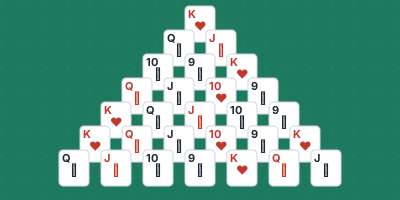
TriPeaks Solitaire is the fastest solitaire variant on this site. Eighteen cards form three peaks, and you clear them by picking any uncovered card exactly one rank above or below the current foundation card. Long chains of picks are where the points live.
How to Play TriPeaks Solitaire
- Eighteen cards are dealt face down into three overlapping peaks of six cards each; the bottom edge of the peaks starts face up.
- One card is turned to the foundation pile beside the stock.
- Click any uncovered card that is exactly one rank higher or lower than the foundation card, regardless of suit. That card moves to the foundation and becomes the new reference.
- Keep chaining - every pick changes what is playable next.
- If no card is one rank away, draw a new card from the stock to the foundation.
- Uncovered cards become available as you strip away the peaks from the bottom up.
- Clear all three peaks of 18 cards to win the round.
TriPeaks Solitaire Rules
Objective
Move all 18 peak cards to the foundation by picking cards one rank above or below the current foundation card.
Setup
Three peaks of 6 cards each (18 cards) on the tableau, plus a stock and one foundation card to start.
Stock
When stuck, draw from the stock. Stock size is limited, and running out with peaks remaining loses the round.
Card Values
Ace and King connect to each other: on an Ace you may pick a King or a 2; on a King, a Queen or an Ace. Suit never matters.
Availability
Only cards with no card overlapping them from below are clickable. Clearing a row exposes the row above it.
Scoring
Chain scoring: consecutive picks without drawing multiply your points per card. Long runs are worth far more than safe single picks.
Strategy
TriPeaks is scored on chains, so the whole game is about not breaking them. Every card you play without drawing extends the chain, and the nth card of a chain is worth n points - which is why one eight-card run is worth far more than eight careful single picks. Before you draw, check both directions: the card one rank above or below the foundation may be sitting on a different peak entirely, and Ace wraps to King so the ends of the range are never dead. Open the middle of each peak early, because the six middle cards each cover two cards and unlocking them is what makes long chains possible. When you do have a choice between two cards of the same rank, take the one that leaves the board with more cards still reachable in both directions.
Common Mistakes
Drawing too early is the classic error: the 33-card stock is a single pass, and every draw resets the chain counter to zero, so one impatient click can cost you the multiplier you spent ten picks building. Players also forget the wrap - Ace and King are neighbours here, unlike in Golf - and lose runs that were sitting right in front of them. A subtler mistake is chasing points instead of clears: taking a short chain now can leave a peak half-covered, and a covered apex is very expensive to reach later. If two peaks are within one rank of the foundation at the same time, always work the one that uncovers more cards before you spend a draw.
Winning
All 18 peak cards cleared before the stock runs out.
Tips & Strategy
- Before drawing from the stock, always double-check both directions - the card you need is often on the opposite peak.
- Remember Ace wraps to King and King wraps to Ace; forgetting the wrap rule costs real runs.
- Try to open the middle of each peak early - it unlocks the most covered cards.
- Hold cheap draws: if you can pick either of two cards, choose the one that leaves more future options on the board.
- Go for chain multipliers when a long run is visible; one 8-card chain beats six cautious single picks.
- A chain of eight is worth 36 points; eight separate one-card picks are worth eight. Plan for the long run.
Frequently Asked Questions
Can I pick a card of any suit?
Yes. Suit is irrelevant in TriPeaks - only rank matters, and only whether it is exactly one step from the foundation card.
Does Ace connect to King?
Yes, ranks wrap: on an Ace you may pick a 2 or a King, and on a King a Queen or an Ace.
How do I score big points?
Chains multiply. Every consecutive pick without drawing from the stock increases the per-card value, so plan long runs instead of quick singles.
What happens when I run out of stock?
If peaks remain and no pick is available, the round is lost. Start a new deal and use your stock more sparingly.
Do Kings and Aces connect in TriPeaks?
Yes. The sequence wraps, so an Ace can be played on a King and a King on an Ace. That wrap is one of the easiest ways to extend a chain.
How does chain scoring work?
The first card you clear scores one point, the second two, the third three, and so on. A chain of eight is worth 36 points against eight points for the same cards taken one at a time - and drawing from the stock resets the chain to zero.
Which cards start face up?
The nine cards of the bottom row are dealt face up. The six middle cards and three peak cards start face down and turn over as the cards covering them are removed.
Is Tri Peaks Solitaire a different game from TriPeaks?
No - Tri Peaks Solitaire is the same game with a space in the name. TriPeaks, Tri Peaks and Three Peaks all refer to the same 18-card layout of three overlapping peaks, played by moving cards one rank higher or lower than the card on the foundation.
How many cards are in a TriPeaks deal?
Fifty-two: 18 cards form the three peaks, 33 sit in the stock and one card starts on the foundation. The nine cards in the base row begin face up, the six middle cards and three apexes are face down and flip automatically once nothing covers them.
Is TriPeaks Solitaire mostly luck?
Much less than Pyramid. Around 80-90% of deals can be cleared by a player who plans the order of the peaks and only draws when a chain is genuinely finished. The stock is generous - 33 cards against 18 on the board - so most losses come from spending draws too early rather than from an impossible layout.
Similar Solitaire Games