Pyramid vs TriPeaks Solitaire: Two Fast Pairing Games Compared
Pyramid and TriPeaks are both quick, satisfying card games where you clear a layout by matching cards. They are often recommended to the same people, but the way you match is completely different - and that difference changes the kind of thinking each game asks for.
| Pyramid | TriPeaks | |
|---|---|---|
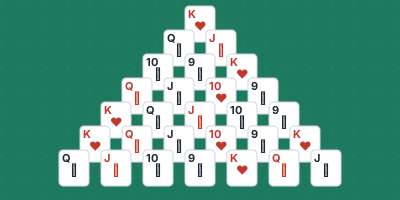
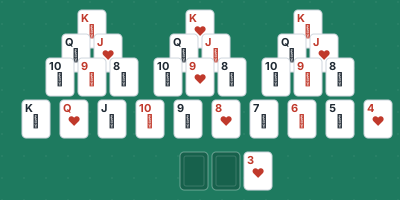
| Cards on the layout | 28 in seven rows | 18 in three peaks |
| How you match | Two exposed cards whose ranks add to 13 | One exposed card that is one rank higher or lower than the current foundation card |
| Kings | Removed on their own, worth 13 | Wrap around: King and Ace are adjacent |
| Chain scoring | Points per pair removed | Each card in a chain scores one more than the last |
| Win rate | Only about 1 in 7 deals (12-16%) | About 8 deals in 10 are clearable with a little planning |
| Typical length | 5 to 10 minutes | 5 to 10 minutes |
Pyramid is about sums
Pyramid deals 28 cards into a seven-row pyramid, and every card is covered by the two cards directly below it. You remove pairs of exposed cards whose ranks total 13: a 6 with a 7, a Queen with an Ace, a Jack with a 2. Kings are worth 13 on their own and go immediately. Because each removal uncovers two more cards, the satisfying part of Pyramid is the cascade - clearing one pair often opens three more options.
TriPeaks is about neighbours
TriPeaks deals 18 cards into three overlapping peaks, with only the nine-card base row face up at the start. One card sits in the foundation, and you remove any exposed card that is one rank higher or one rank lower than it. Kings and Aces are adjacent, so the sequence wraps. Every card you clear becomes the new reference card, which is what allows long chains - and chains are where the score is.
How to play TriPeaks Solitaire
To play TriPeaks Solitaire, look at the card on the foundation and find an exposed card one rank higher or one rank lower: drag it over and it becomes the new target. If nothing fits, draw from the stock. Clear all 18 tableau cards to win, and every card you play without drawing extends a chain, which is where the points are. Tri Peaks Solitaire - the spaced-out spelling - is the same game, and some sites call it Three Peaks.
Chains reward planning in TriPeaks
In TriPeaks each card cleared during a chain scores one more point than the previous one, so a run of eight cards is worth far more than eight separate single removals. The practical skill is choosing which of several legal cards to play in order to keep the chain alive, and holding the stock draw until a chain genuinely breaks. Pyramid has no chain mechanic - the score is steady, and the tension comes from whether the remaining cards can be paired at all.
Which one is more forgiving?
TriPeaks. You can almost always play something, chains recover a bad start, and about eight deals in ten can be cleared with modest planning. Pyramid is harsher: only about one deal in seven (12-16%) is winnable if you do not recycle the stock, and a bad layout can be mathematically dead within a dozen moves. If you want a relaxing five minutes, play TriPeaks. If you want a puzzle that can genuinely beat you, play Pyramid.
When to play each
- Play TriPeaks when you want momentum - something always moves and chains feel great.
- Play Pyramid when you want a tighter puzzle where each removal has to be earned.
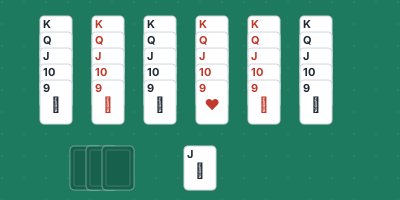
- Play Golf, the third pairing game on this site, if you like the neighbour rule of TriPeaks but want no King wrap and a stricter column-based layout.
Frequently Asked Questions
Do Kings wrap around to Aces in both games?
No. In TriPeaks the sequence wraps, so a King can be played on an Ace and vice versa. In Pyramid there is no wrap - Kings are simply worth 13 and are removed on their own.
Which game has the better win rate?
TriPeaks. Most TriPeaks hands can be cleared with a little planning, while only about one Pyramid deal in seven (12-16%) is winnable without recycling the stock.
How many cards are in each layout?
Pyramid uses 28 cards in seven rows, with the rest in the stock. TriPeaks uses 18 cards in three peaks, with the remaining cards in the stock and one reference card in the foundation.
Is Golf Solitaire similar to TriPeaks?
Yes, Golf uses the same one-rank-higher-or-lower idea, but there is no King-Ace wrap and the layout is seven columns of five cards where you may only take the bottom card of each column.