Golf Solitaire Strategy: How to Clear All 35 Cards
Golf solitaire strategy starts from an awkward fact: it looks like the simplest game on the site and then refuses to end. Thirty-five cards, one rule, and yet finishing is the exception rather than the norm. The reason is that every move changes the number you have to match next, and the version here does not wrap from King to Ace - which quietly turns two of the thirteen ranks into dead ends. Here is how to play for the longest run instead of the first legal card.
The rules, in one breath
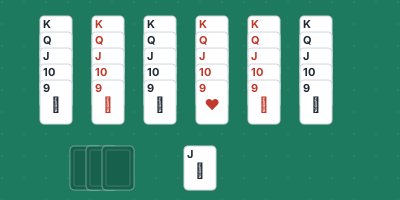
- 35 cards are dealt face up into seven columns of five. Only the bottom card of each column is live.
- One card starts in the waste. You may play any live card that is exactly one rank higher or one rank lower than the waste card.
- That card becomes the new waste card, and the card above it in its column becomes live.
- If nothing fits, draw one card from the stock - 17 cards - onto the waste and try again.
- Aces and Kings do not wrap in this version, so a King only connects to a Queen and an Ace only to a Two.
- Clear all 35 to win. The score is not used; the board counts cards left.
One rule decides almost every game
Because there is no wrap, a King on the waste can only be answered by a Queen, and an Ace only by a Two. Every other rank has two possible continuations, so Aces and Kings are the only cards that halve your options. Treat them as hazards: if you have a choice of two legal cards and one of them puts an Ace or a King on the waste, take the other one - unless the Ace or King is the last card of that rank you can still reach.
Play for the longest run, not the first legal card
Every card you play without drawing extends your run, and every draw stands still. Two legal cards are rarely equal: what matters is which one leaves you on a rank you can keep climbing from. Before you play, ask which play leaves the most live cards of the neighbouring ranks available. That single question separates a round that ends with four cards left from one that ends with twenty.
Choose which column to play from
Playing a card exposes the one above it, so each move is also a decision about which card to unlock. When two columns hold the same rank, play the one whose hidden card helps you - the card that continues the run you are on, or the card that unblocks a rank you are short of. Emptying a column entirely is worth doing when the card underneath is a dead end anyway, because it removes five cards from the board in one go.
Manage the waste rank before you draw
You cannot choose what the stock gives you, so the only thing you control is the rank you are sitting on when you draw. Prefer to draw from a rank with plenty of cards still on the board - if you have already cleared three of the four Sevens, do not leave the waste on a Seven and hope. And never draw while a legal play still exists; a draw is a move you spend, not a move you make.
Count the ranks you are about to run out of
There are four of every rank and 35 cards on the table. If the three Kings you have seen are already gone and the fourth is buried under a column, a run that needs to pass through King is not going to happen. Counting is practical here because the whole board is visible - this is not Klondike, where half the deck is face down.
When a round is already dead
A Golf round ends when no live card matches the waste and the stock is empty. You can usually see it coming: the stock is down to a handful, the remaining cards are spread across ranks you cannot reach, and the live cards are all two or more away from the waste. There is no recovery move in Golf - no empty column to reorganise into, no second pass through the deck. Start a new deal rather than burning minutes on arithmetic.
What counts as a good round
Roughly seven deals in ten are clearable under these rules, so clearing the board is a realistic target rather than a fluke - but it takes the discipline above. Finishing with fewer than five cards left is a strong round; finishing with one or two means you almost certainly had one draw you did not need to take. A perfect round - zero left - is the game's own name for it, and it is worth chasing because it is achievable.
Frequently Asked Questions
How do you play the golf solitaire card game?
Deal 35 cards face up into seven columns of five and start one card in the waste. Play a bottom card that is one rank higher or lower than the waste, and it becomes the new target. When nothing fits, draw from the 17-card stock. Clear every card to win - and remember that in this version Aces and Kings do not wrap.
How do you win at golf solitaire?
Maximise the number of cards you play between draws. That means taking the legal card that leaves you on a rank with the most cards still available, avoiding Aces and Kings on the waste because they cannot wrap, and choosing which column to play from based on the card it will expose.
What are the golf solitaire rules?
Seven columns of five cards, all face up, with the bottom card of each column live. Play a live card one rank higher or lower than the waste; it becomes the new waste and exposes the card above it. Draw from the stock when nothing fits. Clear all 35 cards to win.
Does Golf wrap from King to Ace?
Not in this version. A King only connects to a Queen and an Ace only to a Two. Some versions of Golf allow the wrap, which makes the game noticeably more forgiving - if you learned it elsewhere and the King refuses to play, that is why.
How many cards are left in the stock?
Seventeen. A standard 52-card deck, 35 dealt to the tableau, one card started in the waste, and 17 to draw from. You get one pass - there is no recycling.
Is there any strategy beyond picking a legal card?
Yes, and it is most of the game. Which column you play from decides which card you unlock, which rank you leave on the waste decides what the next draw can help with, and whether you draw at all decides whether your run continues. Two players given the same deal will finish with very different numbers of cards left.
How often can golf solitaire be won?
About 70-75% of deals are clearable with good play under standard rules. That is high for solitaire, which is exactly why the game rewards patience over cleverness - most lost rounds were lost to one unnecessary draw.
Should I empty a column as fast as possible?
Only when the cards beneath are useful or the column is otherwise stuck. Emptying a column removes five cards from the board, but it also removes your only access to whatever was underneath - so empty the columns whose remaining cards are dead ends first.