Solitaire Scoring Explained: Points in Every Variant
Solitaire scoring is not one system - it is a different system per game, and half of them were never meant to be compared with each other. Spider starts you at 500 and charges you a point per move; TriPeaks pays you more the longer your chain runs; Golf does not score at all and just counts the cards you failed to clear. This guide sets out what each score on this site actually measures, and then the classic Windows and Vegas systems you will meet elsewhere.
| Game | What the score counts | Where it starts |
|---|---|---|
| Klondike (Draw 1 / Draw 3) | +10 per card to a foundation, +5 per face-down card uncovered | 0 |
| Yukon | Same as Klondike | 0 |
| Spider (1 / 2 / 4 suits) | 500 start, -1 per move, +100 per completed run | 500 |
| FreeCell | +10 per card sent to a foundation | 0 |
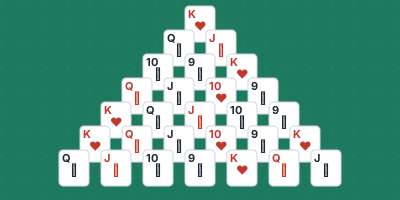
| Pyramid | +1 per card removed from the layout | 0 |
| TriPeaks | Chain bonus: the nth card of a chain scores n points | 0 |
| Golf | No score - the board counts cards left out of 35 | 0 |
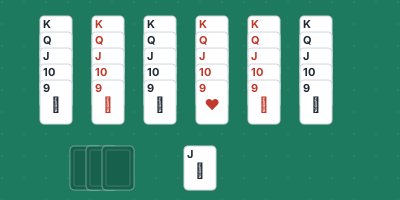
| Scorpion | No score - the game is about clearing, not points | 0 |
Klondike and Yukon
On this site a Klondike or Yukon score is a measure of progress, not of efficiency. You get 10 points for every card that reaches a foundation and 5 points for every move that uncovers a face-down card, and nothing is ever subtracted - recycling the stock is free, and pulling a card back off a foundation costs you nothing. The practical read is simple: a score in the 200s means you cleared roughly half the deck, and a win puts 520 points on the board at minimum.
The classic Microsoft scoring that most players grew up with is stricter, and it is worth knowing because online leaderboards still use it:
- Card to a foundation: +10
- Card from the waste to the tableau: +5
- Uncovering a face-down tableau card: +5
- Card pulled back from a foundation to the tableau: -15
- Recycling the stock: -100 in Draw 1, -20 in Draw 3 (after the first pass)
- Time bonus on a win: 700,000 divided by your finishing time in seconds
Under that system a routine Draw 1 win lands around 500-900, a strong one near 1,300, and anything over 2,000 is exceptional. Draw 3 scores lower for the same player because every stock cycle costs points.
Spider
Spider scoring is the cleanest in solitaire. You start at 500, lose 1 point for every move you make, and gain 100 for every completed King-to-Ace run of one suit. Eight runs and no wasted moves is the theoretical ceiling of 1,300; in practice 500-700 is a good one-suit score, 300-500 at two suits, and simply finishing at four suits is the achievement. The -1 per move is the whole design: it charges you for every rearrangement you did not need to make. The four-suit level has its own page with full rules and strategy: Spider Solitaire 4 Suits.
FreeCell
Our FreeCell scores 10 points per card on a foundation and nothing else, so a win is always 520. Other implementations count 1 point per card, show a percentage of 52, or ignore score entirely and rank you by time - which is reasonable, because nearly every FreeCell deal is solvable and speed is the only thing that separates two winning players.
Pyramid
Pyramid scores 1 point per card removed, so a pair is worth 2 and a King on its own is worth 1. Since only about 12-16% of deals can be cleared at all, the score is really a measure of how close you got: 20-plus means you stripped most of the pyramid, and 28 means you cleared it. Some versions score 10 per pair and add a large bonus for finishing, which is the same idea with bigger numbers.
TriPeaks
TriPeaks is the one game where the score rewards style rather than just progress. The first card of a chain is worth 1 point, the second 2, the third 3, and so on - drawing from the stock resets the counter to zero. A ten-card chain is therefore worth 55 points, against 10 points for clearing the same ten cards one draw at a time. That is why the whole game is about finding the longest unbroken run before you touch the stock.
Golf and Scorpion
Neither game keeps a score here, and that is deliberate. Golf tells you what matters instead: how many of the 35 cards are still on the table. Zero is a perfect round. Scorpion is the same kind of game - the only thing worth recording is whether you cleared the board.
Vegas scoring
Vegas turns Klondike into a wager, and it is the system most likely to surprise you. You buy the deck for $52 - one dollar per card - and earn $5 for every card you land on a foundation. You need 11 cards up before you break even, and clearing the deck pays $260, a profit of $208. Stock passes are usually limited to one in Draw 1 or three in Draw 3, which is what makes it brutal: most hands lose money, and the average player lands around 8-10 foundation cards. The system is real casino history too: it traces back to Richard Canfield's Saratoga room, which is covered in the history of solitaire.
What counts as a good score
- Klondike: 500+ is solid, 900+ is a strong win, 1,300+ is expert territory.
- Spider: 500-700 at one suit, 300-500 at two, and any finish at four suits.
- FreeCell: the score is fixed at 520 - compete on time and move count instead.
- Pyramid: 20+ removed is a good day at a game that only clears 12-16% of the time.
- TriPeaks: judge yourself on your longest chain, not on the total.
- Golf: count the cards left. Under five is a strong round.
A score is only half the ledger, though - it records progress on a deal that may or may not have been winnable at all. The other half is the share of deals that can actually be won, which runs from FreeCell's 99%-plus down to roughly one Scorpion deal in eight.
What is the highest score you can get in solitaire?
There is no single ceiling, because every game counts something different. On this site the maximum is a fixed number in each game except Spider, where it depends on how few moves you need:
| Game | Maximum score | How the maximum is reached |
|---|---|---|
| Klondike (Draw 1 / Draw 3) | 625 | All 52 cards to the foundations (520) plus all 21 face-down cards uncovered (105) |
| Yukon | 625 | The same arithmetic - 21 cards start face down and 52 go home |
| FreeCell | 520 | 52 cards at 10 points each - every win scores exactly this |
| Spider (1 / 2 / 4 suits) | 1,300 | 500 to start, all eight runs completed, no moves charged |
| Pyramid | 52 | Every card removed at 1 point each, but only 12-16% of deals allow it |
| TriPeaks | 171 | All 18 cards cleared in one unbroken chain (1+2+3 and so on, up to 18) |
| Golf / Scorpion | No score | Both count the cards left on the table instead |
Two caveats matter more than the numbers themselves. A Klondike score of 625 simply means you won - the ceiling is set by the win condition, not by how quickly you got there. And Spider's 1,300 is arithmetic rather than a target: every move costs a point, so a four-suit game you actually finish is worth more than any figure in this table.
Frequently Asked Questions
What is the standard solitaire scoring system?
The Windows-style standard system: 10 points for a card to a foundation, 5 for a waste-to-tableau move, 5 for uncovering a face-down card, minus 15 for pulling a card back off a foundation, and a stock penalty of 100 points in Draw 1 or 20 in Draw 3 for each pass after the first.
How is Spider Solitaire score calculated?
Start at 500, subtract 1 for every move, add 100 for every completed King-to-Ace run of a single suit. Eight runs with no wasted moves is a theoretical 1,300.
How do you score Klondike solitaire?
In the classic system every foundation card is worth 10 points and every uncovered face-down card 5, with penalties for recycling the stock and for moving cards back off the foundations. On this site Klondike keeps the same two rewards - 10 for a foundation card, 5 for an uncovered card - but charges no penalties.
What is Vegas scoring in solitaire?
A $52 buy-in and $5 back for every card you get onto a foundation. Eleven cards break even, and clearing all 52 pays $260 for a $208 profit. Stock passes are limited, which is what makes it hard.
How to score solitaire when there is no score to keep?
For Golf, count the cards left on the table - lower is better and zero is perfect. For Scorpion, record whether you cleared the board. Both games are about completion, not accumulation.
Do all solitaire games use the same points?
No, and they were never meant to. Spider starts at 500 and charges per move, TriPeaks pays a rising chain bonus, Pyramid pays per card removed, and Golf and Scorpion do not score at all. Comparing a Spider 700 with a Klondike 700 tells you nothing.
Does the score affect whether you win?
Never, in any of these games. The score measures how you played; the win condition is always about clearing cards. In Spider the score even pushes against the win condition slightly, because every extra rearrangement costs a point.
How does solitaire scoring work?
There is no single system - each variant counts something different, but almost all of them follow one of three patterns. Points for progress: Klondike pays 10 per foundation card and 5 per face-down card uncovered, FreeCell pays 10 per foundation card, and Pyramid pays 1 per card removed. Points for efficiency: Spider starts you at 500, charges 1 point per move and pays 100 for each completed King-to-Ace run. Points for style: TriPeaks pays a rising chain bonus, so an 18-card chain is worth 171 while the same 18 cards taken one at a time are worth 18. Golf and Scorpion keep no score at all. In every case the score measures how you played - it never decides whether you won.
Why is my solitaire score different on other sites?
Because scoring was never standardised. Klondike is the clearest example: this site pays 10 per foundation card and 5 per uncovered card and never subtracts anything, while the classic Windows system also pays 5 for a waste-to-tableau move and charges 15 for pulling a card back off a foundation and 100 or 20 for recycling the stock. Both are called solitaire scoring, and 600 on one is not 600 on the other. Compare scores inside a single implementation, never across two of them.
Do you want a high or low score in solitaire?
Higher, in every variant that keeps a score - points are only ever awarded for clearing cards or uncovering them, never charged for playing well. The real exception is Golf, which keeps no score at all: the number that matters is the cards left on the table, and lower is better. Vegas looks different because the rewards sit on top of a $52 buy-in, but there too a bigger number means you cleared more of the deck.
Play These Games