Solitaire Terms Explained: A Glossary for Every Variant
Solitaire games share a vocabulary, but each variant uses it slightly differently. This glossary explains the words you will meet on every page of Solitaire Grove - from tableau and foundation to supermove and winnable deal - in plain English, with the variant-specific meanings flagged where they differ.
Parts of the board
- Tableau
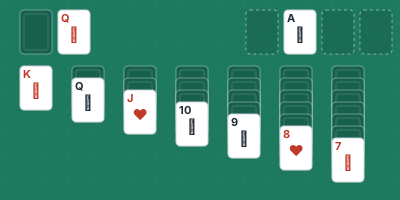
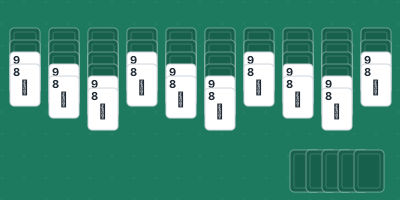
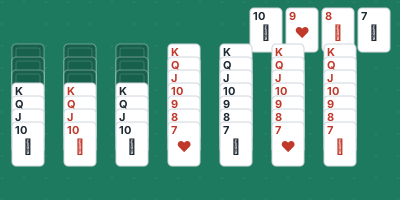
- The main playing area: the columns of cards laid out in front of you. Klondike, Yukon and Scorpion use seven columns, Spider uses ten. Cards in a tableau column overlap, so you can usually only see the rank of the ones near the bottom.
- Foundation
- The goal piles. In Klondike and Yukon there are four foundations, one per suit, each built up from Ace to King. Not every variant has foundations: Spider and Scorpion clear completed runs straight off the board instead.
- Stock (talon)
- The face-down pile you draw from during play. In Klondike it sits at the top left; when it runs out you recycle the waste and go through it again. Yukon has no stock at all - all 52 cards are on the tableau from the first second.
- Waste
- Where cards from the stock go once they are turned face up. In Klondike Draw 1 you can play any card in the waste; in Draw 3 only the top card is available, which is what makes Draw 3 much harder.
- Reserve
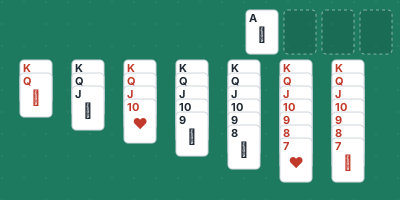
- A small extra stack dealt at the start and used once. Scorpion deals three reserve cards that you may place onto the first three columns exactly one time.
- Free cell
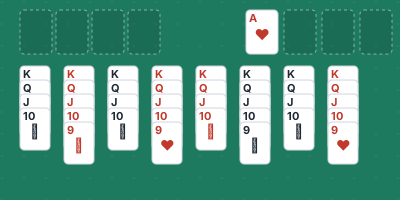
- One of the four temporary parking spots in FreeCell. Each holds a single card and acts as a buffer that lets you move sequences you could not otherwise move.
- Fan (cascade)
- The overlapping column of cards itself, and the offset that reveals part of each card. A fan is what allows you to read a run of five or six cards at a glance.
States a card can be in
- Face-up / face-down
- Whether you can see the card. A face-down card is unplayable until every card on top of it has been moved away.
- Exposed (available)
- A card with nothing covering it. In a fanned tableau column this is the bottom-most card; in Pyramid or Golf it is a card whose covering neighbours have all been removed.
- Buried
- A face-down card with several cards still stacked on top of it. Digging out buried cards is the single most important habit in Klondike, Spider and Yukon.
- Run (sequence)
- Two or more cards in rank order, usually descending: 9-8-7. A run only counts as a single movable unit when the variant allows it - see supermove below.
- Colour vs suit
- Alternating colours means red on black or black on red (Klondike, Yukon for dropping, FreeCell). Same suit means spades on spades, hearts on hearts, and so on (Spider for moving, Scorpion for both).
Actions
- Deal
- Lay out the opening layout. Every game on this site deals a random layout with a fresh shuffle each time you press New Game.
- Draw / redeal
- Take one or more cards from the stock. A redeal is what happens when the stock is empty and you flip the waste back over to start again - Klondike allows unlimited redeals.
- Build up / build down
- Foundations build up (Ace to King). Tableau piles build down (King to Ace) in almost every variant.
- Transfer (supermove)
- Moving a whole run from one column to another in a single action. Klondike, FreeCell and Spider let you transfer a properly ordered run as one unit; Yukon and Scorpion are more generous and let any group of face-up cards travel together.
- Flip
- Turn a newly exposed face-down card face up. Flips are free information - they are the reason experienced players clear the deepest column first.
- Undo
- Step back one move. Every game here keeps a full history so you can undo as far back as the start of the hand.
Strategy and scoring terms
- Empty column
- A tableau column with no cards left. It is the most valuable real estate on the board: Klondike and Yukon only accept a King (or a run led by a King), while Spider lets you park any card there.
- King-only column
- The empty-column rule used by Klondike, Yukon and Scorpion: only a King may start a new column there.
- Blocking card
- A low card trapped under a run you need. Holding a needed Ace or Two on the tableau rather than sending it to the foundation is the classic way to avoid creating one.
- Safe move
- A move that cannot make your position worse - typically a flip, or moving a card you will not need again. Playing only safe moves is why FreeCell is winnable more than 99% of the time.
- Winnable deal
- A layout that could be solved with perfect play, whether or not you personally find the solution. A lost game does not mean the deal was impossible.
- Perfect play
- The theoretical best line, used by solver software to measure how winnable a deal is. Human players rarely reach it, which is why win rates in the wild are far below solver results.
- Dead end
- A position with no legal moves left and cards still on the board. Pyramid, TriPeaks and Golf end this way most often.
- Chain (combo)
- A string of consecutive matches without drawing, as in TriPeaks, where each cleared card scores one more point than the last.
Why the words change between variants
The same word can mean different things depending on the game. An empty column takes any card in Spider but only a King in Klondike. A group of cards moves together freely in Yukon and Scorpion but only when it is a properly ordered run in Klondike and Spider. And a foundation exists in Klondike but not in Spider, where a completed King-to-Ace run simply leaves the board. When in doubt, read the rules section of the specific game page - it always describes what that game actually does.
Why is solitaire called patience?
Patience is the older British name for the whole family of single-player card games, and the name comes from what the games ask of you: you wait, you build slowly, and plenty of deals never resolve at all. Solitaire became the default word in the United States largely because the version bundled with Windows shipped under that name. Today both words mean the same thing, and most solitaire sites list variants under whichever term their audience searches for.
Frequently Asked Questions
Is solitaire the same thing as Patience?
Yes. Patience is the traditional British and Commonwealth name for the same family of single-player card games. Solitaire is the North American name, and it is the one most people search for today, so that is what we use across the site.
What does tableau mean in solitaire?
The tableau is the main playing area - the columns of overlapping cards in front of you. It is where you build descending sequences and where most of the decisions in a game happen.
What is the difference between the stock and the waste?
The stock is the face-down pile you draw from. The waste is the face-up pile those cards go into after you draw them. When the stock empties, the waste is turned back over and becomes the stock again.
What is a supermove?
A supermove is moving a whole ordered run of cards from one column to another in one action, instead of dragging them one at a time. Klondike, FreeCell and Spider allow it for correctly ordered runs; Yukon and Scorpion allow any group of face-up cards to travel together.
What does it mean when a deal is called winnable?
It means a solver has proved that some sequence of moves clears all 52 cards. It does not mean the solution is easy or obvious - it just means the layout is not impossible. Losing a winnable deal is normal, and improving at spotting the line is most of the fun.
Play These Games