FreeCell vs Klondike: Which Game Rewards Skill More?
FreeCell and Klondike look almost identical on screen - seven columns, four foundations, one deck - but they feel nothing alike to play. The difference comes down to a single design choice: Klondike hides information, FreeCell does not. That choice changes everything about how you win.
| Klondike | FreeCell | |
|---|---|---|
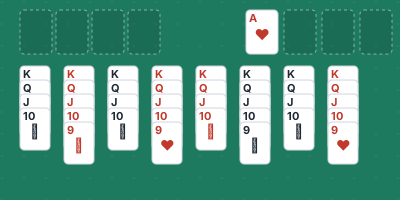
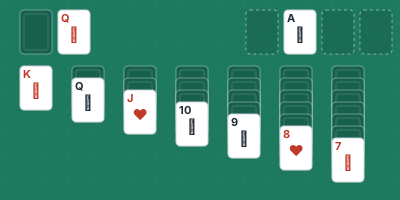
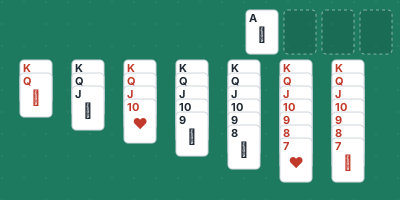
| Hidden cards | 21 cards start face down | None - all 52 cards are face up from the first move |
| Stock | Yes, recycles indefinitely | No stock at all |
| Extra storage | None | Four free cells, each holding one card |
| Empty column | Kings only | Any card |
| Solvable deals | About 82% winnable with perfect play | Over 99% of deals are solvable |
| Role of luck | Large - many deals are simply impossible | Small - almost every loss is a mistake you made |
| Typical length | 10 to 15 minutes | 15 to 25 minutes |
The difference between FreeCell and Klondike in one line
Klondike hides 21 cards and gives you a stock you can recycle; FreeCell hides nothing and gives you four free cells instead. Everything else - the seven columns, the four foundations, the alternating-colour building rule - is identical. That single design choice is why Klondike has a luck component and FreeCell does not.
Information is the whole game
In Klondike you start with 21 face-down cards and discover them gradually. Part of the skill is deciding which column to dig into, and part of the frustration is discovering too late that the card you needed was buried third from the bottom of a pile you never opened. In FreeCell every card is visible from move one. There is no hidden information, which means every decision is a real decision rather than a gamble.
Free cells replace the stock
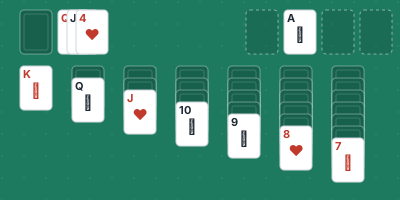
Klondike gives you a recycling stock as its pressure valve: stuck now, draw more cards and try again later. FreeCell gives you four free cells instead - single-card parking spots that let you temporarily lift a card out of the way so the card beneath it can move. Used well, four cells plus one empty column let you shift an entire run of cards you could never move otherwise. Used carelessly, they fill up in the first ten moves and the board locks.
Empty columns: kings only versus anything
This is the second big difference. Klondike accepts only a King in an empty column, so an empty column there usually means a King is about to be placed and a buried stack is about to open. FreeCell lets any card or any run move into an empty column, which makes them the most powerful resource on the board - and the reason experienced players free one up as early as possible.
Win rates and what they really mean
Solver studies put Klondike Draw 1 at about 82% of deals winnable with perfect play, and the number drops sharply for Draw 3. FreeCell is solvable in more than 99% of deals - the famously unsolvable deal number 11982 from the original Microsoft version is a statistical curiosity, not the norm. The practical consequence: in Klondike you will lose games that were never winnable, and in FreeCell almost every loss was avoidable. If that idea appeals to you, FreeCell is your game. If you prefer the drama of a deal that might be doomed from the start, Klondike is.
Which should you learn first?
- Start with Klondike if you want the classic game everyone recognises and a forgiving 10 minute session.
- Start with FreeCell if you like puzzles you can actually reason your way through, and if losing to bad luck annoys you.
- Move from Klondike to FreeCell when you want wins that feel earned rather than dealt.
- Move from FreeCell to Klondike Draw 3 when FreeCell starts to feel predictable.
Frequently Asked Questions
Is FreeCell easier than Klondike?
In terms of solvable deals, yes - more than 99% of FreeCell deals can be solved, against roughly 82% for Klondike Draw 1. In terms of thinking effort, FreeCell is harder, because there is no hidden information to blame and every loss was your own decision.
Why does FreeCell have no stock pile?
Because all 52 cards are dealt face up onto the tableau at the start. The four free cells take the place of a stock: they give you temporary storage instead of extra cards.
Can any card go in a FreeCell empty column?
Yes, in FreeCell an empty column accepts any single card or any ordered run. In Klondike only a King may occupy an empty column.
Is deal 11982 really unsolvable?
Yes. Deal number 11982 in the original Microsoft FreeCell set of 32,000 is the famous case that cannot be solved. It is one of a handful of unsolvable deals ever documented, which is why the solvable rate is usually quoted as over 99% rather than 100%.
Freecell or Klondike - which is better for you?
Pick FreeCell if you want a puzzle whose outcome depends on your decisions: about 99.97% of deals are solvable, so a loss is something you can learn from. Pick Klondike if you want a shorter, more familiar game where the deal itself still matters - faster to play, but some hands are unwinnable no matter what you do.
What is the FreeCell vs Klondike win rate?
FreeCell sits at about 99.97% of deals solvable, with skilled players winning 85-95% of them. Klondike Draw 1 is about 82% winnable with perfect play, but human players win 30-40% in Draw 1 and 15-25% in Draw 3. The gap between those two columns is the gap between a game of skill and a game of luck.
Play These Games