Klondike vs Spider Solitaire: Which One Should You Play?
Klondike and Spider are the two most-played solitaire games in the world, and they look similar enough that new players often assume they are the same game with a different layout. They are not. The goal, the deck, the building rules and the difficulty are all different. Here is the full comparison.
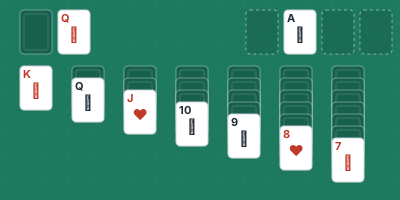
The difference between Klondike and Spider in one line: Klondike clears cards out of the tableau into four foundations while you fight a stock, whereas Spider keeps everything in the tableau and only clears a completed King-to-Ace run of a single suit.
| Klondike | Spider | |
|---|---|---|
| Decks | 1 deck (52 cards) | 2 decks (104 cards) |
| Columns | 7 | 10 |
| Goal | Move every card to four foundations, Ace to King by suit | Build four King-to-Ace runs of one suit, each of which leaves the board |
| Tableau building | Descending, alternating colours (red on black, black on red) | Descending, any suit may be placed, but only same-suit runs move as a group |
| Empty column | Kings only | Any card |
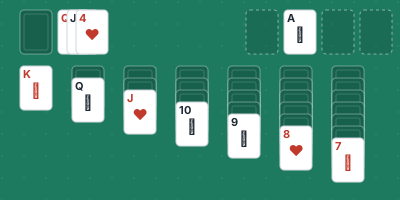
| Stock | Recycles indefinitely | Five waves of ten cards, no recycling |
| Typical game length | 10 to 20 minutes | 15 to 40 minutes |
| Win rate | About 82% with perfect play in Draw 1 | Very winnable at 1 suit, much harder at 2 suits |
The goal is completely different
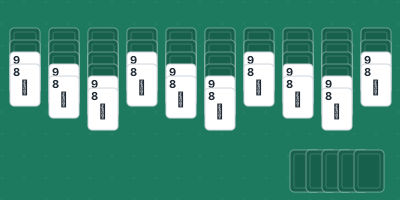
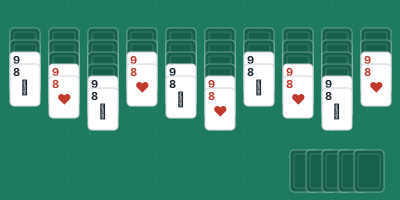
Klondike sends cards to four foundations, one per suit, each built from Ace upward. You win the moment the last King lands. Spider has no foundations at all: instead you assemble complete King-to-Ace runs of a single suit inside the tableau, and each finished run is lifted off the board. In our one-suit Spider every card is a spade, so any completed run counts. In two-suit Spider you must match suits properly, which is where the difficulty comes from.
Building: alternating colour versus same suit
In Klondike a red 8 goes on a black 9, and colour is all that matters. In Spider you may place any card on a card exactly one rank higher regardless of suit - a heart 8 can sit on a spade 9 - but that pile is now broken for scoring purposes, because only a run of one suit can be completed and removed. This is the central tension of Spider: every convenient placement in the wrong suit is a debt you pay later.
Group moves are much stricter in Spider
Klondike lets you drag any correctly built alternating run as a single unit. Spider only lets a group travel when it is a strictly descending run of one suit, so mixed-suit piles have to be taken apart card by card. That single rule is why a Spider board can look healthy and still be lost.
Empty columns behave differently
In Klondike only a King may occupy an empty column, which makes them scarce and precious. In Spider any card can be parked there, so empty columns are a routine tactical tool rather than a rare prize. If you are coming from Klondike, this is the biggest adjustment.
Which one should you play?
- Play Klondike if you want a 10 to 15 minute game with a familiar rhythm, a stock you can recycle when stuck, and a rule set you probably already know.
- Play Spider 1-suit if you want a longer, calmer puzzle where patience pays off and the win rate is genuinely high.
- Play Spider 2-suits when you want the hardest of the three and are happy to win roughly one hand in three in exchange for a real sense of accomplishment.
- Play Klondike Draw 3 instead of Draw 1 if Klondike has become too easy - same rules, far fewer winnable deals.
How to switch between them
All four versions are on Solitaire Grove and use the same controls: drag or tap to move cards, undo any number of moves, and press New Game for a fresh shuffle. Nothing is installed and nothing is tracked, so switching costs you nothing but the hand you are playing.
Frequently Asked Questions
Is Spider Solitaire harder than Klondike?
One-suit Spider is generally easier than Klondike Draw 3 and comparable to Klondike Draw 1, because empty columns accept any card and you get five full waves of new cards. Two-suit Spider is considerably harder than either Klondike variant.
Why does Spider Solitaire use two decks?
Two decks give you eight copies of each rank, which is what makes long same-suit runs possible. The one-suit version uses two decks of the same suit pattern; the two-suit version splits them across two suits.
Can I move mixed-suit cards together in Spider?
No. You may place any card onto a card one rank higher, but only a strictly descending run of a single suit can be moved as a group. Mixed piles have to be dismantled one card at a time.
Which game takes longer?
Spider. A Klondike hand usually finishes in 10 to 15 minutes, while a two-suit Spider game can run 20 to 40 minutes because there are twice as many cards and no recycling of the stock.
Play These Games