Solitaire History: From Patience to Windows
Solitaire history is younger than most people assume. The cards are old, but the idea of a game played against yourself instead of an opponent is a little over two centuries old, and the version the world calls simply "Solitaire" is younger than the telephone. This is the short version: where patience came from, what the Napoleon story is worth, how Klondike got its name, and the one business decision at Microsoft that turned a card game into the most-played computer game in history.
Where patience came from
The earliest written references to single-player card games appear in northern Europe - Germany and Scandinavia - in the late eighteenth century. Card-game historian David Parlett traces the earliest safely dated reference to around 1758, recorded in an 1801 biography of the German composer Carl Friedrich Fasch. The first appearance in a printed games anthology came in a German edition of Das neue Koenigliche L'Hombre-Spiel, where the game was called both Patience and Cabale.
Early patience was not purely a pastime. Some layouts were used for fortune-telling, with the outcome read as an answer to a question. The shift to recreation happened in nineteenth-century France, where patience became a parlour fashion, and then in Victorian Britain, where printed collections such as Illustrated Games of Patience (1870) fixed layouts that are still recognisable today.
The Napoleon legend
The most repeated story in solitaire history is that Napoleon Bonaparte invented the game during his exile on Saint Helena from 1815 until his death in 1821. It is almost certainly a myth - written references to patience predate the exile by decades - but it is a persistent one, and several games carry his name, including Napoleon at St Helena, which is essentially what we now call Forty Thieves. What the legend does capture is real: by the 1850s patience was a fixture of European leisure.
Klondike and the gold rush
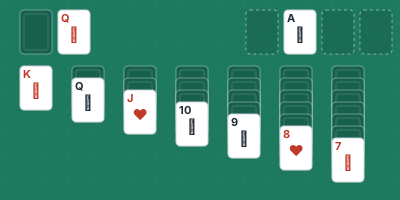
Klondike - the game most English speakers mean when they say solitaire - takes its name from the Klondike Gold Rush of 1896-99 in Canada's Yukon Territory. Whether the rules were invented in the mining camps or simply became inseparable from them is not documented, and closely related games such as Canfield and Fascination appear in earlier European collections. What is clear is that Klondike entered North American card culture through the gold rush and never left.
Canfield: the casino version
In the late nineteenth century the casino operator Richard A. Canfield ran a room in Saratoga Springs, New York, where players paid $52 for the right to play one hand - a dollar a card - and were paid $5 for every card they got onto a foundation. Most players lost. The game survives as Canfield Solitaire, also known as Demon Patience, and the pricing survived too: it is the origin of the Vegas scoring system still used online. The break-even point is eleven cards, and it is further away than it looks.
| Year | What happened |
|---|---|
| 1758 | Earliest safely dated reference to a patience game |
| 1801 | Zelter's biography of Fasch records the game |
| 1815-1821 | Napoleon's exile on Saint Helena - the legend |
| 1870 | Illustrated Games of Patience codifies the layouts |
| 1896-1899 | Klondike Gold Rush gives Klondike its name |
| 1968 | Baker's Game described in Martin Gardner's Scientific American column |
| 1978 | Paul Alfille computerises FreeCell on the PLATO system |
| 1990 | Microsoft ships Solitaire with Windows 3.0 |
| 1998 | Spider Solitaire arrives with Microsoft Plus! 98 |
| 2012 | Microsoft Solitaire Collection bundles five variants in one app |
FreeCell: a mathematician's game
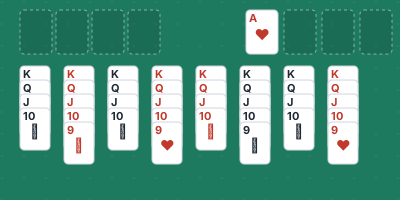
FreeCell is the one classic variant with a documented inventor. In June 1968 Martin Gardner's Mathematical Games column in Scientific American described Baker's Game, named for C.L. Baker. Paul Alfille modified the rules so that tableau columns build by alternating colour rather than suit, and in 1978 implemented his version on the PLATO educational computer system - the FreeCell we play today. Because every card is dealt face up, it is also the variant where skill matters most: all but eight of Microsoft's original 32,000 deals are solvable.
Spider and the rest
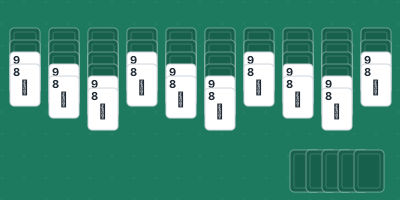
Spider's early history is murky; one account dates it to 1949 and ties the name to the eight foundations a completed game needs, like a spider's legs. What is not in doubt is how it spread: Microsoft shipped Spider Solitaire with the Plus! 98 add-on for Windows 98 in 1998, and that is where almost everyone met it. Pyramid, sometimes called Tut's Tomb, has roots in the early twentieth century, and both Pyramid and TriPeaks reached a mass audience through Microsoft's Entertainment Packs and later the Microsoft Solitaire Collection.
The Microsoft moment
In 1990 Microsoft bundled Klondike with Windows 3.0. It was written by an intern, Wes Cherry, and it had a purpose beyond entertainment: dragging cards around a board was a friendly way to teach office workers to use a mouse. It worked better than anyone expected. Microsoft added FreeCell a few years later, Spider in 1998, and by the collection's thirtieth anniversary in 2020 it reported more than 35 million monthly players and over 100 million games a day. Wes Cherry received no royalties.
After Windows
The web moved solitaire into the browser in the late 1990s, and mobile apps in the 2010s added daily challenges and leaderboards. The interesting thing is how little the games themselves changed: the rulesets for Klondike, FreeCell, Spider, Pyramid and TriPeaks settled decades ago and have barely moved since. What changed is that you no longer need to own a deck, find a table, or install anything.
About this page and trademarks
Solitaire Grove is an independent website. We are not affiliated with, endorsed by, or sponsored by Microsoft Corporation, and we have no relationship with any other solitaire game, app or publisher. Microsoft, Windows and Microsoft Solitaire Collection are trademarks of their respective owners and appear on this page only as factual references in a historical timeline. The rules of the games described here are traditional patience and solitaire rules that have been played for more than two centuries; game rules and mechanics are not protected by copyright, and every explanation on this page is written by us.
Frequently Asked Questions
Who invented solitaire?
No one person. Patience games appear in northern European sources from the late eighteenth century, and the first printed rules were collections rather than inventions. Klondike's name comes from the 1896 gold rush, but its ruleset has no known author. FreeCell is the exception: Paul Alfille created it in 1978, building on Baker's Game.
When was solitaire invented?
The earliest safely dated reference is around 1758, in German-speaking Europe. Patience became a published, codified pastime through the nineteenth century, with Klondike named after the gold rush of 1896-99.
Did Napoleon invent solitaire?
Almost certainly not - written references to patience predate his exile on Saint Helena by decades. He may well have played it there, which is likely where the story comes from.
Why is it called patience in Britain and solitaire in America?
Patience is the older British and European term for any single-player card game; solitaire is the American term, derived from the French word for solitary. They describe the same family of games.
Why did Microsoft put solitaire on Windows?
To teach people to use a mouse. Dragging cards is a natural way to learn click, double-click and drag-and-drop, and Windows 3.0 was the first Microsoft operating system with a mass graphical audience. The side effect was the most-played computer game in history.
How old is the history of Klondike solitaire?
Klondike as a named game goes back to the gold rush era of the late 1890s, so roughly 130 years. Closely related layouts such as Canfield are older, but the seven-column game most people play today cannot be dated further back with any confidence.
Is solitaire history the same as the history of peg solitaire?
No. Peg solitaire is a board-and-pegs puzzle with a separate history, and mahjong solitaire is a tile-matching game that borrowed the solitaire name later. This page is about the card games.
When did solitaire come out?
Two answers, depending on what you mean. As a card game, its written history starts in late eighteenth-century northern Europe, and printed collections codified the games through the nineteenth century. As a computer game, it came out with Windows 3.0 in 1990, which is when it became a household name; Spider followed in 1998, and FreeCell joined the Windows bundle in 1992.
Play These Games